Kalamkari
What is Kalamkari Painting?
Kalamkari is an ancient style of hand-painted or block-printed cotton textile art that originated in the Indian states of Andhra Pradesh and Telangana. The name reveals how it is made. It comes from the Persian words "kalam" (meaning pen) and "kari" (meaning craftsmanship). So, literally translated, it means "pen-work".
A unique aspect of Kalamkari is its strict adherence to nature and tradition. It is a slow, multi-step art form that relies entirely on natural dyes and organic materials. While the art form shares a common heritage, it evolved into two distinct styles named after the regions where they flourished
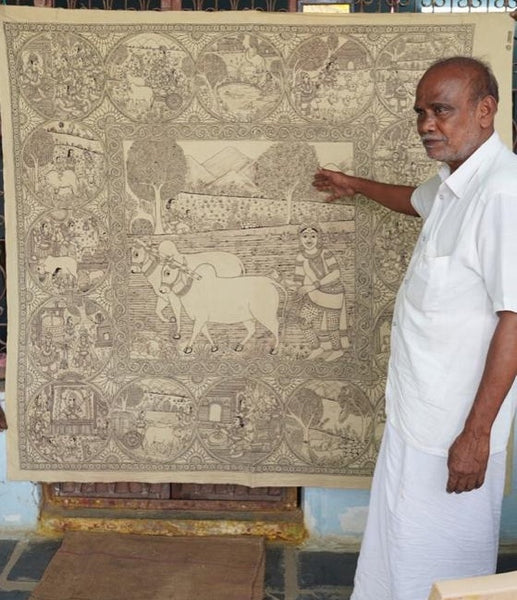
The “Srikalahasti Style” is called the pure "pen" style. Artists use a sharp bamboo reed pen to freehand sketch lines and fill in colors. Historically, this style centered heavily around temples, so the themes are deeply religious, depicting scenes from Indian epics like the Ramayana and Mahabharata, alongside portraits of gods and goddesses.
The “Machilipatnam Style” relies primarily on hand-carved wooden blocks rather than freehand sketching. The artist stamps the outlines and major patterns onto the fabric, using the pen mainly for the intricate background details. The designs here lean more toward floral patterns, vines and Persian-influenced motifs, largely due to patronage from the Golconda Sultanate.
Key Features of Kalamkari Painting
Kalamkari paintings are renowned for their intricate hand-painted and block-printed designs, vibrant natural dyes and narrative compositions that depict themes from mythology, religion and folklore. Characterized by elaborate floral motifs, decorative borders, and finely detailed figures, Kalamkari reflects a harmonious blend of artistic expression and cultural heritage. These artworks are valued for their eco-friendly techniques and their role in preserving India's rich devotional and artistic traditions.
Some defining features of this artform include:
Hand-Drawn or Block-Printed Designs
Use of Natural Dyes
Mythological and Religious Themes
Intricate Detailing
Eco-Friendly Process
Cotton-Based Textile
Distinctive Borders and Decorative Patterns
Narrative Art Form
Regional Heritage
Kalamkari combines painting, dyeing and storytelling, making it one of India's most important traditional textile arts. It reflects religious beliefs, cultural traditions and the artistic heritage of South India.
History of Kalamkari Painting
Origin of Kalamkari Painting
The roots of Kalamkari run deep, spanning over 3000 years of history. Its origin is a fascinating journey that evolved from ancient storytelling scrolls into a highly prized luxury trade item coveted across the globe.
Long before it was a fashion textile, Kalamkari was a tool for education and worship. In ancient India, groups of musicians, singers and painters known as Chitrakars or Duanas wandered from village to village. They would unroll large, hand-painted cotton scrolls depicting the stories of Hindu mythology.
Because many villagers could not read, these illustrated backdrops acted as a visual aid while the performers sang stories from the Ramayana and Mahabharata. Over time, this specific scroll art found a permanent home inside temples, evolving into large canvas backdrops called temple hangings.
Evolution of Kalamkari Painting
The art form underwent a massive shift during the Middle Ages under the patronage of the Golconda Sultanate (around the 14th to 17th centuries). Before this era, the locals simply referred to the craft as Puranapata (mythological canvas). The rulers of Golconda were heavily influenced by Persian culture, and they fell in love with the intricate pen work. They officially termed these textiles "Kalamkari" (Kalam for pen, Kari for craftsmanship).
Under Islamic rule, the Machilipatnam region shifted its artistic focus away from depicting Hindu deities to suit the tastes of the Sultanate. Artists began integrating delicate Persian flora, geometric patterns and the iconic “Tree of Life” motif. They also adapted the technique to use hand-carved wooden blocks to scale production for trade.
By the 17th and 18th centuries, Kalamkari became a major driver of international trade. European traders discovered the textile along the Coromandel Coast of India.
The Europeans called this painted and printed cotton "Chintz" (derived from the Hindi word chint, meaning spotted or variegated).
Unlike European textiles of the time, the brilliant reds and blues in the textiles never faded when washed, instead, they grew brighter. As a result, it became so widely used for upholstery, curtains and high-end dresses in England and France that it threatened the local European weaving industries, leading both countries to temporarily ban the import of Indian “chintz" to protect their domestic markets.
Through thousands of years of shifting kingdoms, religions and global trade demands, the core technique passed down through generations of artisans remains remarkably unchanged today.
Contemporary Kalamkari Painting
While traditional Kalamkari remains anchored in temple hangings and ancient epics, contemporary Kalamkari represents a massive design evolution. Modern Kalamkari reimagines how the art looks and where it is applied.
In the contemporary art world, Kalamkari is no longer treated just as a textile craft but as fine gallery art. Instead of loose scrolls, artists are creating standalone paintings on heavy stretched canvas or premium handmade paper designed explicitly to be framed for minimalist, modern living spaces.
Traditional Kalamkari is famous for being incredibly dense, leaving almost no empty space on the fabric. Contemporary artists are embracing a more "breathable" design language. They isolate single, iconic elements, like a stylized peacock, a single deity portrait or a lone tree and surround them with clean, unpainted neutral space to match the aesthetics of contemporary homes.
Kalamkari Paintings Themes and Motifs
The themes and motifs of Kalamkari act as a visual language. Because this art form evolved along two distinct geographic and cultural paths, its iconography is incredibly rich, ranging from elaborate religious epics to stylized, geometric natural elements.
Divine Epics and Mythology (Srikalahasti Style)
In its earliest historical form, Kalamkari was a visual alternative to holy texts. The paintings are dominated by cinematic narratives from ancient Indian epics.
Epics: Artists paint scenes from Ramayana such as Sita’s Swayamvar, the exile of Rama from Ayodhya, the battle between Rama and Ravana; some even contain the entire story as a visual narrative. With respect to the Mahabharata, Krishna delivering the Bhagavad Gita to Arjuna on the battlefield is a popular depiction.
Puranas: Tales of Gods, Goddesses and their various incarnations (Avatars) are highly popular. You will frequently see Vishnu reclining on the cosmic serpent, Shiva performing Tandava or Durga killing the buffalo demon Mahishasura.
Narrative Text Panels: A unique thematic feature of this style is the inclusion of text. Short explanations or verses are painted directly beneath the characters in local scripts (often Telugu) to explain exactly what is happening in that specific panel.
Secular Nature and Persian Courts (Machilipatnam Style)
As the Machilipatnam style was heavily patronized by Islamic rulers (the Golconda Sultanate), it bypassed human and divine depictions, focusing instead on decorative, worldly beauty.
Royal Court Life: Early secular pieces depicted noblemen, royal processions, hunting scenes and musicians playing traditional instruments.
Decorative Elegance: The focus shifted toward symmetry, geometric harmony and repetitive patterns meant for luxury clothing and wall canopies.
Within these overarching themes, certain motifs repeat constantly across Kalamkari works. Each carries its own deep symbolic meaning.
The Tree of Life (Kalpavriksha)
This is the most common and popular of Kalamkari motifs, bridging both the traditional and contemporary eras. It features a grand, twisting tree growing from a small mound of earth, its branches bursting with highly intricate leaves, fruits and perched birds. It represents the interconnectedness of all life on earth, creation, fertility and spiritual growth. In contemporary art, it is widely loved because it is completely non-religious and globally appreciated.
The Peacock (Mayura)
Peacocks appear everywhere in Kalamkari, recognizable by their oversized, heavily detailed, teardrop-shaped tail feathers. They are rarely drawn realistically; instead, they are highly stylized with swirling, vine-like patterns filling their bodies. They are associated with royalty, pride, divine love and beauty. From a more religious point of view, the peacock is also associated with Saraswati (the goddess of wisdom) and Murugan (the god of war).
Animals
Animals are rendered with distinct, expressive features. Common depictions include elephants with decorated carpets on their backs, roaring lions with stylized manes and gentle deer looking over their shoulders. In the symbolic aspect, elephants embody wisdom, royalty, and strength, lions represent courage and sovereign power, while deer symbolize peace, innocence and the calm of nature.
The Lotus (Kamala)
The lotus is the structural foundation of Kalamkari borders and centerpieces. It is depicted in various stages, from tight, elegant buds to fully unfurled, symmetrical circular medallions (Mandalas). Lotus motifs represent purity and spiritual awakening. Within religious symbolism, it serves as the physical throne for Lakshmi and Brahma.
Vine Creepers (Valli) and Borders
The edges and backgrounds of Kalamkari paintings are filled with Valli, intricate, continuous floral vines that twist and turn to connect different scenes. They represent the continuous, uninterrupted flow of time and life.
A key design element in Kalamkari is that a painting is never "open." Every piece is framed by tight, highly complex geometric or floral borders. These borders act as a visual boundary, separating the sacred or natural world depicted inside the painting from the mundane world outside it.
Materials Used in Kalamkari Paintings
Natural Pigments Used in Kalamkari Paintings
One of the most distinctive features of Kalamkari painting is its use of natural pigments derived from plants, minerals and other organic materials. Traditional artisans follow an eco-friendly process in which colours are prepared from naturally available substances and fixed onto the fabric using natural mordants. These pigments not only produce rich and earthy tones but also contribute to the durability and authenticity of the artwork.
The use of natural pigments reflects the sustainable nature of Kalamkari art. These colours blend harmoniously with the fabric, age gracefully over time, and contribute to the distinctive visual appeal of the paintings. Moreover, the traditional knowledge involved in preparing and applying these pigments has been passed down through generations, making it an integral part of Kalamkari's cultural heritage.
Colours Used in Kalamkari Paintings
Black: Black is traditionally obtained from a mixture of iron filings, jaggery and water that is allowed to ferment for several days. This natural ink is used to outline figures, draw intricate details, and define the composition. The bold black lines are a characteristic feature of Kalamkari and provide clarity to the narrative scenes.
Red: Red is produced from natural sources such as madder root or through the use of alum as a mordant combined with vegetable dyes. This colour is commonly used for garments, decorative motifs and architectural elements.
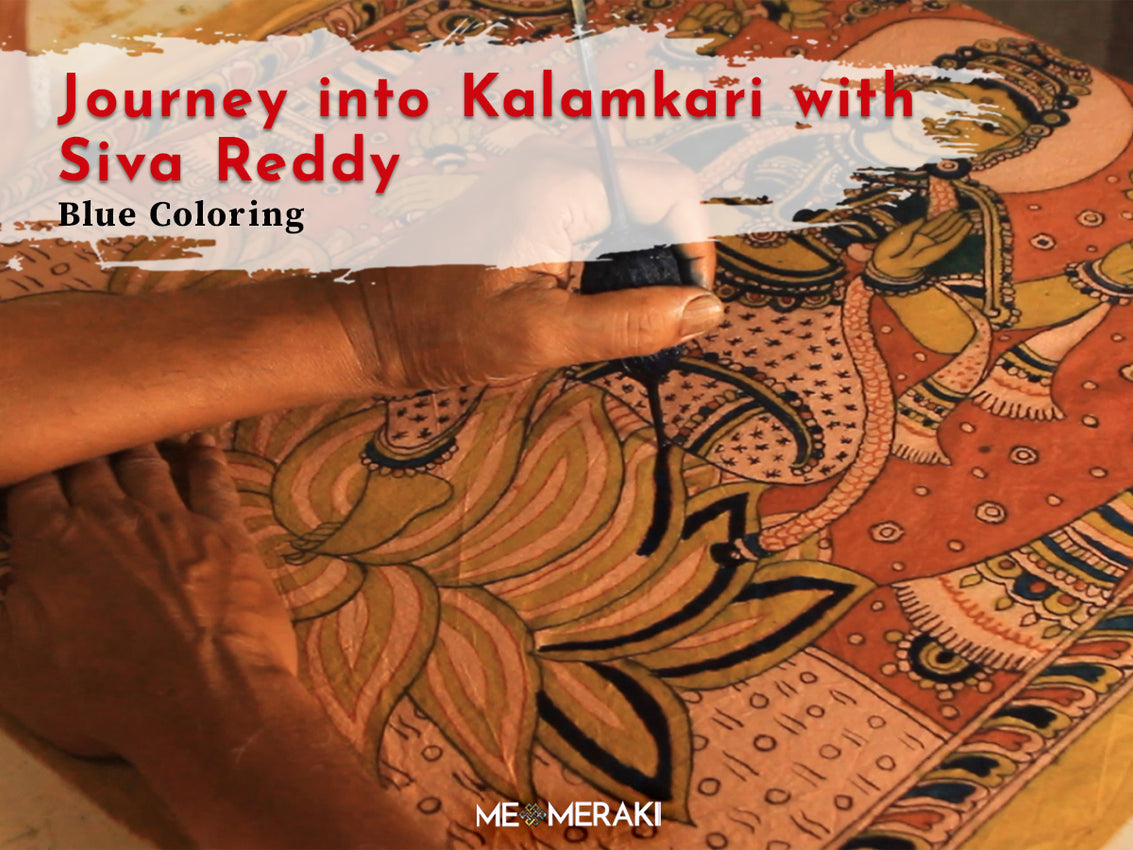
Blue: Blue is derived from indigo, one of the oldest natural dyes used in India. Extracted from the leaves of the indigo plant, it is used to colour backgrounds, clothing, water bodies and decorative patterns. The deep blue hue is especially associated with depictions of Lord Krishna.
Yellow: Yellow is obtained from natural materials such as pomegranate rind, turmeric or myrobalan fruit. It is frequently used to depict ornaments, clothing, flowers and sacred objects.
Green: Green is created by combining indigo blue with yellow dyes obtained from plant sources. It is commonly used for leaves, trees, landscapes and other natural elements.
Brown and Earth Tones: Various shades of brown and earthy colours are produced using plant extracts, bark, roots and natural mineral compounds. These tones help create depth and realism in the artwork while maintaining the organic aesthetic characteristic of Kalamkari.
White: Unlike other colours, white is generally obtained from the untreated fabric itself. Artists carefully preserve portions of the cloth to create highlights, patterns and contrast within the composition.
Tools Used in Kalamkari
The tools used in Kalamkari are simple yet highly effective, reflecting centuries of artisanal knowledge and craftsmanship. Their use allows artists to create detailed, expressive, and durable works while maintaining the traditional techniques that define Kalamkari as one of India's most celebrated textile arts.
Kalam (Bamboo Pen)
The most important tool in Kalamkari is the kalam, a hand-crafted pen made from a bamboo stick with a pointed tip wrapped in cotton or wool. The cotton acts as a reservoir for ink or dye, allowing the artist to draw smooth and controlled lines. Different kalams are used for outlining, shading and filling colours.
Wooden Blocks
In the Machilipatnam style of Kalamkari, artisans use intricately carved wooden blocks to print designs onto the fabric. Each block is carved with a specific motif, such as flowers, leaves or geometric patterns. Multiple blocks are often used to create complex compositions and repeating decorative elements.
Brushes
Although the kalam remains the primary drawing instrument, fine brushes are sometimes used for colouring larger areas, adding details and applying finishing touches. Brushes help achieve smooth colour transitions and delicate ornamentation.
How Kalamkari Painting is Made
Kalamkari is an art of intensive labor, taking up to 23 individual steps to complete a single piece of cloth. Here is a look at how an artist transforms plain cotton into a vibrant piece of art. The basic steps include the following:
Fabric Treatment: Bleaching & Softening
The cotton cloth is washed in a river to remove starch, then soaked in a mixture of buffalo milk and Myrobalan (a natural astringent fruit seed). This prevents the natural dyes from smudging or running later on.
Sketching the Outline: The Bamboo Pen
Using a charcoal stick made from burnt tamarind twigs, the artist freehands the design. They then darken the lines using a bamboo pen dipped in kasim, a black liquid made from fermented iron filings and jaggery.
Coloring: Extracting from Nature
Colors are applied one by one using a specialized rag-wrapped pen. Every single shade comes from the earth.
Washing and Fixing: The Final Set
After each color application, the fabric is thoroughly washed in running river water. It is a delicate dance of boiling, washing and sun-drying to lock the colors permanently into the fibers.
Famous Kalamkari Artists
Ghanshyam Sarode
Ghanshyam Sarode is a contemporary Kalamkari artist known for his mastery of Srikalahasti and Narayanpet traditions. His artworks frequently feature Tree of Life compositions, peacocks, birds and nature-inspired themes, distinguished by intricate hand-drawn detailing, natural dyes and a strong connection to traditional Kalamkari storytelling.
Harinath N.
Harinath N. is one of the most accomplished Kalamkari artists from Srikalahasti, Andhra Pradesh, with over three decades of experience in the craft. A recipient of the National Kalidas Academy Award, he is renowned for his elaborate depictions of scenes from the Ramayana and Mahabharata, as well as Tree of Life narratives, executed through intricate linework and traditional natural dyes.
Md. Bilal
Md. Bilal is a contemporary Kalamkari artist celebrated for preserving the traditional aesthetics of hand-painted Kalamkari while introducing refined decorative compositions. His works often draw inspiration from Indian mythology, nature and folk traditions, showcasing meticulous detailing and vibrant natural colour palettes.
K. Lakshminarayan
K. Lakshminarayan is a Kalamkari artist from Tamil Nadu known for his vibrant interpretations of folk, devotional and nature-inspired subjects. His paintings frequently depict Krishna, peacocks, classical dancers, birds and tribal celebrations, characterised by bold outlines, intricate motifs and lively colour combinations rooted in traditional Kalamkari craftsmanship.
Kanukurthi Guna Sekhar Sai
Kanukurthi Guna Sekhar Sai is a contemporary Kalamkari artist whose work reflects the rich artistic heritage of Andhra Pradesh. His paintings often combine traditional Kalamkari techniques with detailed narrative compositions inspired by mythology, temple art and cultural symbolism, showcasing exceptional precision and craftsmanship.
Mannasamudram Viswanath Reddy
Mannasamudram Viswanath Reddy is known for creating intricate Kalamkari artworks rooted in the Srikalahasti tradition. His works frequently explore themes from Hindu mythology, sacred symbolism and nature, demonstrating a strong command of hand-drawn linework, natural dyes and classical storytelling techniques.
Siva Reddy
Siva Reddy is a Kalamkari artist recognised for his dedication to preserving the traditional Srikalahasti style. His artworks often depict epic narratives, deities and symbolic motifs through detailed penwork, natural colours and carefully balanced compositions that celebrate the heritage of Kalamkari painting.
Sridevi Ponnambalam
Sridevi Ponnambalam is a contemporary Kalamkari artist whose works blend traditional techniques with a distinctive decorative sensibility. Her paintings often feature mythological subjects, flora, fauna and cultural motifs rendered through intricate detailing and harmonious colour palettes that highlight the elegance of the Kalamkari tradition.
Sudheer
Sudheer is a master Kalamkari artist known for creating highly detailed works inspired by mythology, folklore and nature. His paintings showcase the intricate freehand drawing and natural dye techniques characteristic of the Srikalahasti tradition, while bringing timeless narratives to life through rich visual storytelling.
Varun Kumar Pitchuka
Varun Kumar Pitchuka is a contemporary Kalamkari artist celebrated for his refined hand-painted compositions rooted in traditional Andhra Pradesh craftsmanship. His artworks often feature mythological themes, sacred iconography and nature-inspired motifs, combining meticulous detailing with a contemporary visual appeal suited to modern collectors and interiors.
Kalamkari Paintings for Home Decor
Kalamkari paintings have become a popular choice for home decor because of their artistic beauty, cultural significance and timeless appeal. Their intricate designs, vibrant natural colours and storytelling elements add warmth and character to both traditional and contemporary interiors.
Framed Kalamkari paintings are often used as statement pieces in living rooms, as gallery walls, in hallways and bedrooms. Mythological scenes, depictions of deities and nature-inspired motifs create visually striking focal points while adding a sense of cultural richness to the decor.
Kalamkari designs are also widely incorporated into home furnishings such as curtains, cushion covers, bedspreads, table runners and upholstery fabrics. As many Kalamkari paintings feature religious themes and images of Hindu deities, they are also frequently used in prayer rooms and meditation spaces.
Kalamkari Paintings for Gifting
Kalamkari paintings make meaningful and distinctive gifts for weddings, anniversaries, housewarmings, festive occasions and cultural celebrations. Renowned for their intricate craftsmanship, natural dyes and rich storytelling traditions, these artworks embody artistic heritage, spirituality and timeless elegance.
Handmade Kalamkari paintings featuring scenes from the Ramayana and Mahabharata, depictions of deities, the Tree of Life, peacocks, lotus flowers and other nature-inspired motifs are especially valued as gifts for their symbolic and cultural significance. Whether presented as framed artworks, decorative wall hangings or handcrafted textile pieces, Kalamkari creations offer a unique blend of tradition, craftsmanship, and aesthetic beauty.
Their eco-friendly production methods and enduring artistic appeal make them cherished gifts that celebrate India's rich cultural legacy while adding warmth and character to any space.
FAQs About Kalamkari Paintings
Where did Kalamkari painting originate?
Kalamkari originated in the present-day states of Andhra Pradesh and Telangana and has a history spanning over 3,000 years. The art form developed into two major regional styles: the Srikalahasti style, known for its freehand pen-drawn designs, and the Machilipatnam style, which relies on hand-carved wooden blocks. Both styles evolved under different cultural influences while retaining their traditional techniques. Today, they continue to represent the rich artistic heritage of South India.
What is the difference between the Srikalahasti and Machilipatnam styles of Kalamkari?
The Srikalahasti style is entirely hand-drawn using a bamboo pen and is primarily associated with storytelling through mythological and religious themes. In contrast, the Machilipatnam style uses hand-carved wooden blocks to create intricate patterns and decorative motifs. The latter shows strong Persian and Islamic influences due to the patronage of the Golconda Sultanate. Together, these two styles represent the diverse evolution of Kalamkari art.
Why are natural dyes important in Kalamkari?
Natural dyes are a defining feature of Kalamkari and play a crucial role in preserving its authenticity. They are derived from environmentally sustainable sources and produce rich, earthy colours that blend harmoniously with the fabric. Unlike synthetic dyes, natural colours age gracefully and contribute to the artwork's traditional aesthetic appeal. Their use also reflects the eco-friendly and sustainable nature of the craft.
Does Kalamkari have a Geographical Indication (GI) Tag?
Yes, Kalamkari has received Geographical Indication (GI) status, which helps protect its authenticity and regional identity. The hand-painted Srikalahasti style received GI recognition in 2007, while the block-printed Machilipatnam style was awarded GI status in 2013. The GI tag safeguards traditional production methods and prevents the misuse of the craft's name by unauthorized producers. It also supports artisan communities by promoting genuine Kalamkari products in national and international markets.
What is the significance of Kalamkari under the ODOP (One District One Product) initiative?
Kalamkari has been promoted under the One District One Product (ODOP) initiative as a representative craft of its region. The programme aims to strengthen local economies by supporting traditional products with unique cultural and historical value. Through ODOP, Kalamkari artisans receive assistance in marketing, branding, skill development, and access to wider markets. This initiative helps preserve the craft while creating new economic opportunities for artisan communities.
How long does it take to create a Kalamkari artwork?
Creating a traditional Kalamkari artwork is a labour-intensive process involving up to 23 different stages. These include fabric preparation, sketching, dyeing, washing, drying, and finishing. Depending on the complexity and size of the design, a single piece can take anywhere from several days to several weeks to complete. The time and effort involved contribute significantly to the value and uniqueness of each artwork.
How is Kalamkari used in contemporary times?
Today, Kalamkari is used in a wide variety of applications beyond traditional temple hangings and narrative scrolls. It can be found in sarees, dress materials, scarves, wall art, home furnishings, and contemporary decorative pieces. Many modern artists have also adapted Kalamkari techniques to create framed artworks suited to contemporary interiors. This adaptability has helped the craft remain relevant while preserving its traditional roots.
Why is Kalamkari considered an important part of India's cultural heritage?
Kalamkari is more than a decorative art form; it serves as a visual medium for preserving mythology, folklore, and historical traditions. For centuries, it helped communicate religious stories to communities through illustrated narratives. Its traditional techniques, natural materials, and symbolic motifs embody generations of artistic knowledge and cultural memory. As a result, Kalamkari is regarded as an important expression of India's artistic and spiritual heritage.
Why are Kalamkari paintings popular for home décor and gifting?
Kalamkari paintings are valued for their intricate craftsmanship, vibrant natural colours, and rich cultural symbolism. They add elegance and character to living spaces while reflecting India's artistic traditions. Themes such as the Tree of Life, lotus, peacocks and mythological scenes make them meaningful decorative pieces. Their handmade nature and cultural significance also make them thoughtful gifts for weddings, anniversaries, housewarmings, and festive occasions.
Where can I buy authentic Kalamkari paintings online?
Collectors and art enthusiasts looking to buy authentic Kalamkari paintings online can explore MeMeraki’s curated collection of traditional and contemporary artworks created by skilled Indian artists and artisans. From hand-painted Srikalahasti Kalamkari artworks depicting scenes from the Ramayana, Mahabharata and Hindu mythology to block-printed Machilipatnam designs featuring the Tree of Life, peacocks, lotus motifs and intricate floral patterns, these collections showcase the richness and diversity of the craft.